 |
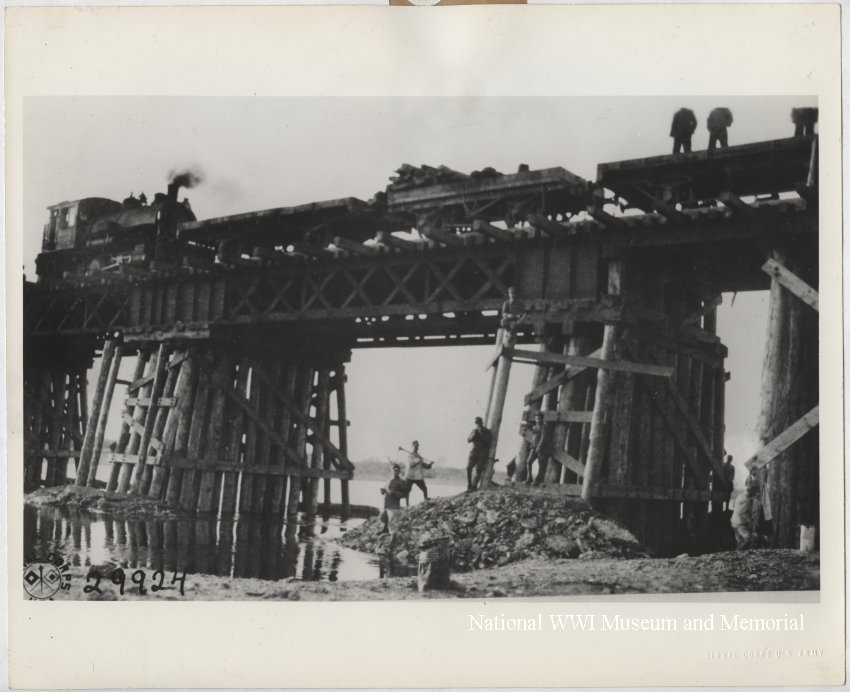
| Bridge worked on by Harold D. Leddy's battalion, Nevers, France, from the National WW Museum and Memorial web site |
 |
| Harold D. Leddy dog tags |
Richard Gilliam contacted me and it turns out that his grandfather was in the same battalion in WW1 as mine, Harold D. Leddy. Richard has done a lot of research on the battalion and the regiment. He has graciously allowed me to post material from his letters to me. My father, John B. Leddy, had told me that the regiment was all-black. Gilliam's research contradicts this family story, although apparently after initial deployment in France there were in fact African Americans in the regiment.
"According to a Regimental Roster, 23rd Engineers printed in 1920, there was a Harold D. Leddy of Company F living at 3020 Kansas Ave., Los Angeles, Cal. listed. My grandfather served in Company F, 23rd Engineers from Washington State where I live."
I was unaware of the 3020 Kansas Ave. address. That address now sports a very modern looking grammar school. Gilliam goes on in a later letter to say:
"The 23rd Engineer was an all white regiment consisting of technical Companies A thru L (4 battalions, 3 companies each), 10 Truck companies 1 thru 10 and 5 Wagon companies 1 thru 5. My grandfather and yours served in company F, 2nd Battalion which embarked Hoboken NJ for France aboard the USS George Washington on March 30, 1918 and arrived Brest on April 13, 1918. They debarked Brest, France aboard USS Plattsburg on June 7, 1919 and arrived Hoboken NJ on June 16, 1919. My grandfather received final pay and discharged at Camp Lewis, Tacoma, Washington on June 27, 1919.
The 23rd Engineers in the early days of their arrival had no support regiments so most of the work done was with pick, shovel wheel barrels. Later on, they were supplemented by colored service regiments, Vietnamese, Chinese, French and POWs. The technical, Truck and Wagon companies were spread throughout France not only building, repairing, maintaining roads but building bridges, barracks, rail roads, work and storage buildings, dams and other miscellaneous jobs as required.
I have to say that I learned quite a bit about grandfathers regiment and history. I started with just his dog tags and a few stories that my father told me. Grandpa passed away in 1941 when my father was 15. Father claims that his death was early due to grandfather's exposure to gas at the forward zone. I believe that I found supporting documentation for that in my research."
My grandfather also suffered from exposure to gas throughout his life. Mr. Gilliam also provided me with a copy of the two page Company F's commanding officers Experience report. From that I determined that in April 1918 the Company was working on the bridge in Nevers, France, on the Loire. This corresponds to the photograph at the beginning of this post. The construction of the bridge is further described in the Historical Report of the Chief Engineer, Including All Operations of the Engineer Department, American Expeditionary Forces, 1917-1919
United States. Army. American Expeditionary Forces. Engineer Dept, January 1, 1919, U.S. Government Printing Office, pp. 283-4 which is available through Google Books here It was the longest bridge which the Engineers of the American force built in France.
Mr. Gilliam also sent me the ship manifest port of embarkation Hoboken, NY which shows Harold's residence as 18 East Colorado. This was right next to Perkins and Leddy's Furnishings at 16 East Colorado. [Could he just have been using the store address as his home address?]
I also learned from Mr. Gilliam that on Oct. 28, 1918 a cloudy and cold day, Company F moved into the northern French town of Charpentry. They were shelled and several were wounded. This was reported in a history of Company A. Also, earlier, back in the U.S. on Jan 9 it was very cold and Company F arrived in Laurel [Deleware?] and moved into the mill there. This information can be found here. You have to search under "F."
Wikipedia informs us that "At the beginning of the Meuse-Argonne Offensive (26 September – 11 November 1918), the 79th US Infantry Division captured Charpentry"
Also there was a publication of Company F in which Harold D. Leddy is listed as a member. The Squeek, 1930. His address there is 181 N. Lake Ave., Pasadena. This area is no longer residential.
My grandfather also suffered from exposure to gas throughout his life. Mr. Gilliam also provided me with a copy of the two page Company F's commanding officers Experience report. From that I determined that in April 1918 the Company was working on the bridge in Nevers, France, on the Loire. This corresponds to the photograph at the beginning of this post. The construction of the bridge is further described in the Historical Report of the Chief Engineer, Including All Operations of the Engineer Department, American Expeditionary Forces, 1917-1919
United States. Army. American Expeditionary Forces. Engineer Dept, January 1, 1919, U.S. Government Printing Office, pp. 283-4 which is available through Google Books here It was the longest bridge which the Engineers of the American force built in France.
Mr. Gilliam also sent me the ship manifest port of embarkation Hoboken, NY which shows Harold's residence as 18 East Colorado. This was right next to Perkins and Leddy's Furnishings at 16 East Colorado. [Could he just have been using the store address as his home address?]
I also learned from Mr. Gilliam that on Oct. 28, 1918 a cloudy and cold day, Company F moved into the northern French town of Charpentry. They were shelled and several were wounded. This was reported in a history of Company A. Also, earlier, back in the U.S. on Jan 9 it was very cold and Company F arrived in Laurel [Deleware?] and moved into the mill there. This information can be found here. You have to search under "F."
Wikipedia informs us that "At the beginning of the Meuse-Argonne Offensive (26 September – 11 November 1918), the 79th US Infantry Division captured Charpentry"
Also there was a publication of Company F in which Harold D. Leddy is listed as a member. The Squeek, 1930. His address there is 181 N. Lake Ave., Pasadena. This area is no longer residential.


